
JOHN CAVANAUGH
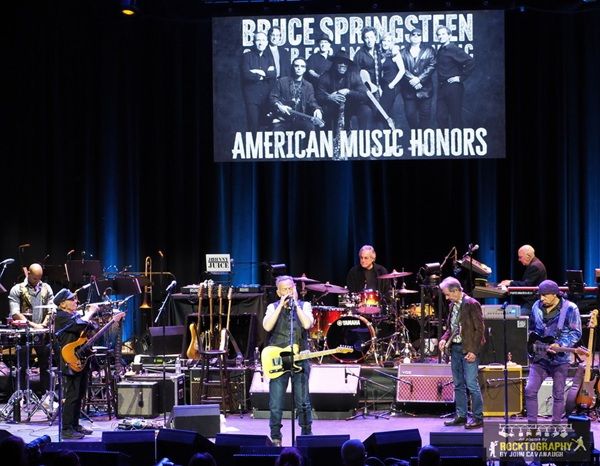
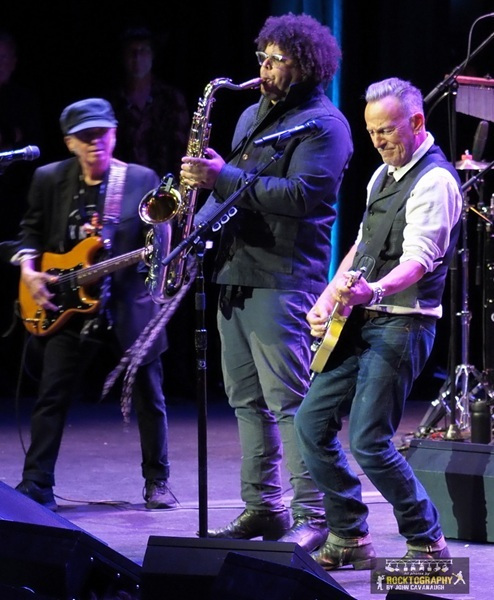
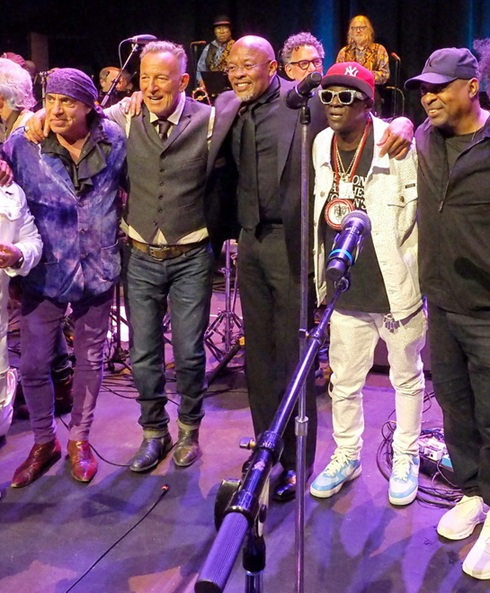
From left, Nils Lofgren, Jake Clemons and Bruce Springsteen perform “Thunder Road” after The E Street Band received its American Music Honors award.
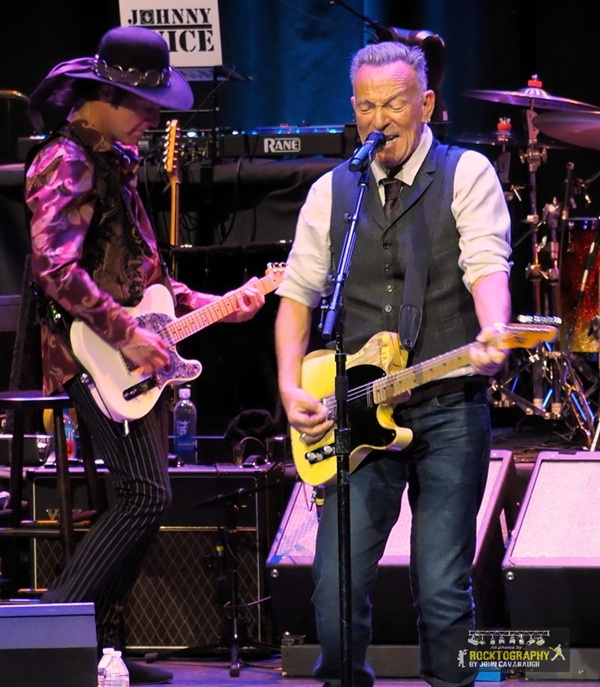
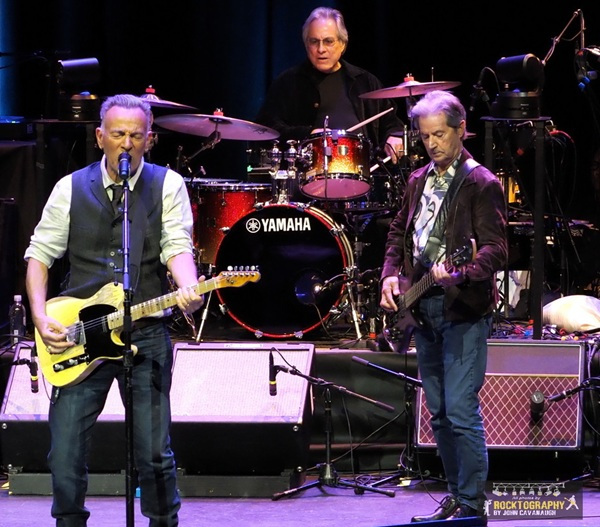
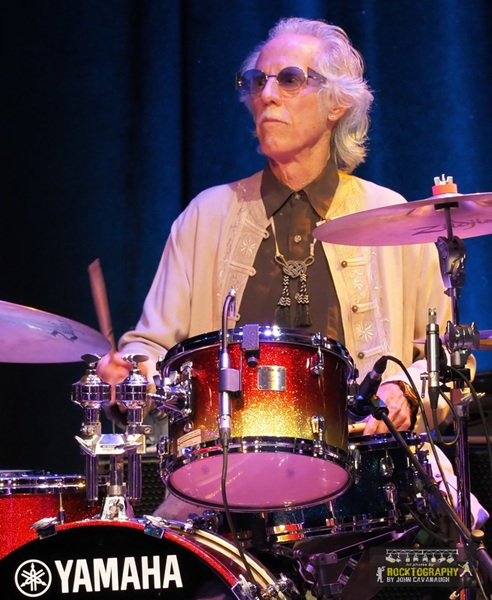
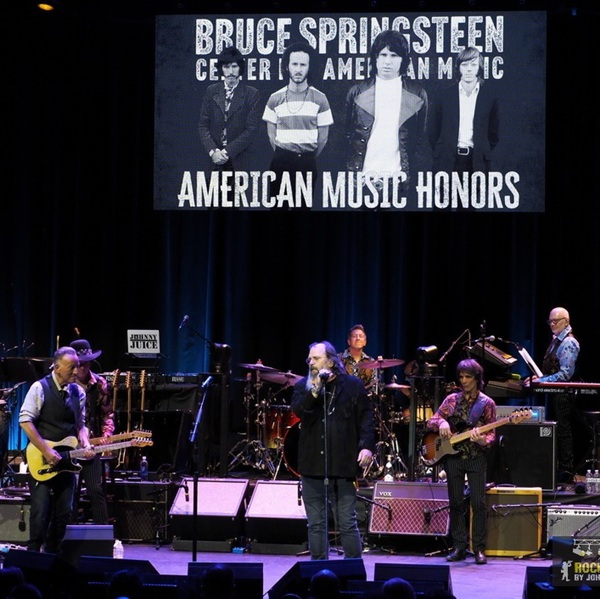
“I haven’t sung this since the CYO dance in 1967,” said Bruce Springsteen before performing The Doors’ “Light My Fire” with Stevie Van Zandt’s Disciples of Soul band, joined by The Doors’ John Densmore on drums, at the American Music Honors show at The Pollak Theatre at Monmouth University in West Long Branch, April 18.
This was the fourth annual edition of the show, presented by The Bruce Springsteen Center for American Music (which will open its doors in June) and honoring The E Street Band, Patti Smith, Dr. Dre, The Doors, Dionne Warwick and The Band. Like the previous ones, it was a joyful celebration. But I’m pretty sure, it was the longest one, lasting more than three hours — as well as the loosest, and the most surprised-filled.
Surprise guests Darlene Love, Public Enemy, Steve Earle and Amy Helm all performed. Smith sang The Doors’ “Crystal Ship” in addition to dueting with Springsteen on “Because the Night,” and leading the grand finale, “People Have the Power.”
Dr. Dre didn’t perform one of his own songs, but he did participate in “People Have the Power,” singing along and playing a tambourine, after being encouraged to take the stage by Smith.
The Disciples of Soul, led by guitarist Marc Ribler, served as the show’s house band, leaving the stage only for The E Street Band’s “Thunder Road,” and Brian Williams served as the show’s genial host for the third straight year. Williams noted that he shares a hometown, Middletown, with Van Zandt. “We try to be modest about it,” he said. “I mean, you’ll never hear us overtly brag that we have both (exits) 114 and 117 on the Parkway. That’s not our style. We know it to be true.”
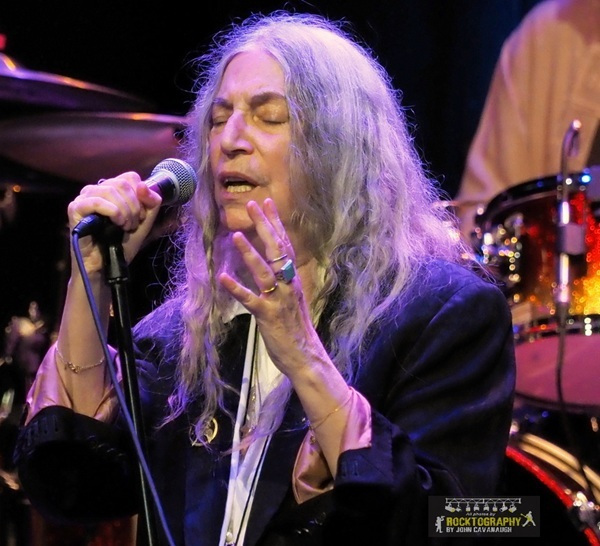
Smith was honored last, and her segment was also the emotional high point of the evening.

JOHN CAVANAUGH
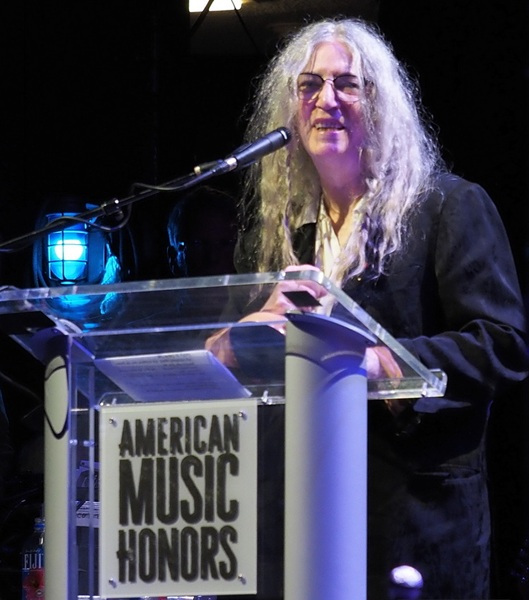
Patti Smith at the American Music Honors show.
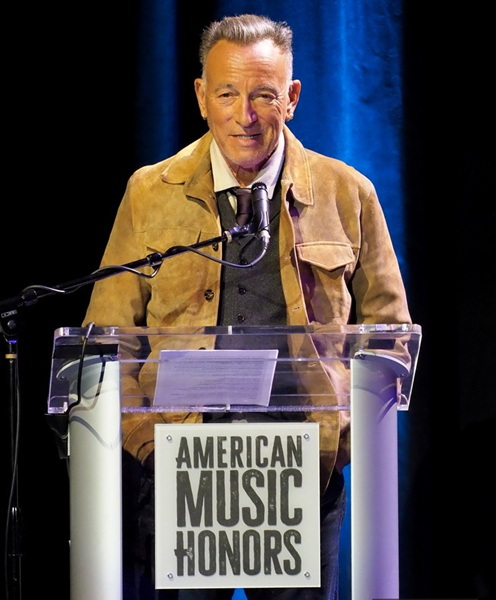
“Tonight, we gather to honor a singular force in American culture,” said Springsteen, in his induction speech. “My great friend and love, Patti Smith. Before all the revolutionary records, before the legend, there was a young poet who grew up in South Jersey and arrived in New York. Nothing but imagination, talent, soul, spirit, love, anger, fearlessness, attitude, resolve. And in the crucible of downtown Manhattan, the grit of the CBGB scene, she didn’t just find her voice, she really redefined what a rock ‘n’ roll voice could be. When Horses was released in 1975, I listened to it and said, ‘What the fuck am I gonna do now?’ … It was so powerful. It didn’t politely enter the culture. It kicked the door in, and Patti … you probably won’t remember this, but I remember it very clear. We were in Manhattan and I met you on a street corner by accident. I said, ‘Patti, hi, what are you doing?’ And you said, ‘I’m just waiting to take over the world!’ I said, ‘Oh, fuck, she is.’ I remember that like it was yesterday.
“But her music fused poetry and rock ‘n’ roll in a way that felt both ancient and revolutionary. It reminded us that music could still be dangerous, it could still be sacred, and it could still be free. Patti’s not just a performer. She is one of our bridges between, obviously, Bob Dylan and The Ramones, between Arthur Rimbaud and the restless spirit of rock ‘n’ roll. She brought literature to the stage, an electricity to the stage. Her voice was always incantation, declaration. It always carried … an overwhelming and merciless conviction. I’m a showman. My good friend Patti is a shaman. She brings forth … the Spirit, whether it’s invoking the fire of youth, the grief of loss, the quiet persistence of faith — Patti Smith has never flinched. She has stood, again and again, for art that matters. Through decades of change, she has remained furiously herself. She is uncompromising, she is unadorned, and she is always unmistakably human. In an industry driven by trends, she’s been guided, her whole career, by this one thing: the truth. The fucking truth.”‘
Smith started her acceptance speech by saying she didn’t have prepared remarks. But she then spoke eloquently of her life and career.

JOHN CAVANAUGH
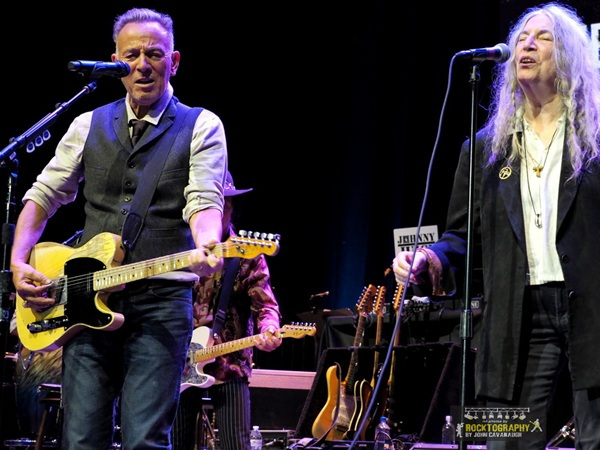
Bruce Springsteen and Patti Smith perform at the American Music Honors show.
When she first came to New York at the age of 20, she said, “I really didn’t have much. I had always had a lot of hubris. I don’t know where from, but I’ve had that — a willing to work. But I somehow encountered such great people. It was Bobby Neuwirth who first suggested that I should transform my poems into songs. I never thought of that myself. Everything for me was poetry; everything stemmed from poetry. It was Sam Shepard who told me I should have some guitar behind me as I, you know, rapped my poems, or spewed them. And these two men sort of sent me on my way. And then it was Lenny Kaye who first played guitar with me, and things evolved organically.”
She started to tear up, and took a moment to compose herself before continuing by talking about received “Because the Night” in 1977 as a Springsteen demo, passed along to her by producer Jimmy Iovine. She finished it as a love song about Fred “Sonic” Smith of the band MC5, whom she had met the previous year. They married in 1980 and Fred Smith died in 1994, at the age of 46.
“Fred did not live a long time, but he lived long enough to give me two wonderful children and to teach me more about singing, about the world, about politics, about the revolution of the heart. And this song (‘Because the Night’),” said Patti Smith. “Also, it was my biggest song — my only big song. Until Fred wrote another one (‘People Have the Power’). But it allowed me to communicate with more people. That’s what a song … when you have a song that so globally touches people, and Bruce and Jimmy gave me a song that allowed me or gave me a platform, an opportunity to reach more people about many other things. But the core of it, again, was poetry and love.”
About Springsteen’s induction speech, she joked, “I never even knew you liked my stuff so much. I knew you liked me. I mean, that was … I’ll cherish every word that you said for the rest of my life. And it will give me the courage and some more strength, to keep on going.”
She then sang Because the Night,” with Springsteen on guitar and backing vocals, and Tony Shanahan of her own band joining the Disciples of Soul on keyboards.
“Fred wrote this for you,” Smith told the crowd before the evening’s final song, the empowerment anthem “People Have the Power.”

JOHN CAVANAUGH
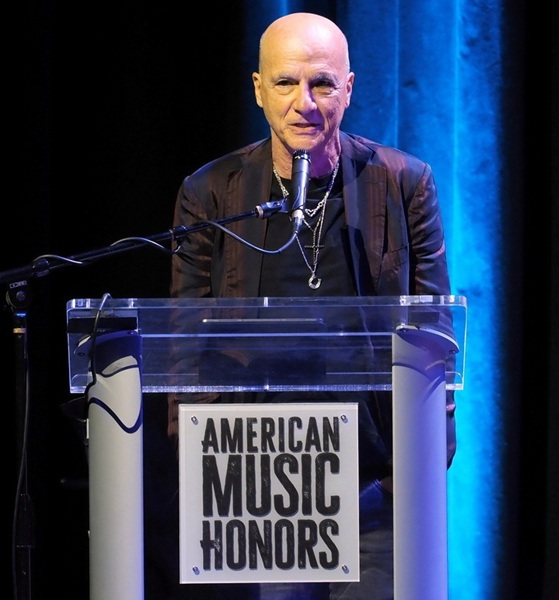
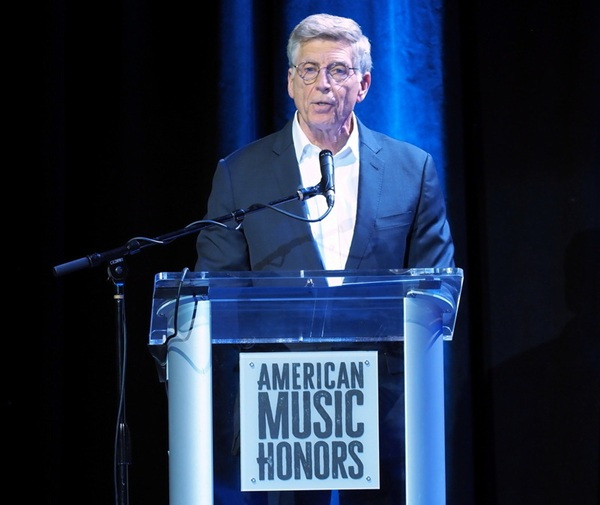
Jon Landau talks about The E Street Band.
Earlier in the evening, Jon Landau, Bruce Springsteen’s longtime manager, had inducted The E Street Band. “No modern computer or algorithm would have ever chosen this group of people to work together,” he said. “Such different backgrounds, styles, tastes and approaches to music. And yet, as we all know, when they plug in and play, they create a sound like no other, a sound you’ve never heard before, a sound more monumental than any rock band has ever created — now and, in my opinion, forever.
“How that happens is a bit of a mystery. Our great friend Tom Morello says that when he started preparing for one of his occasional appearances with E Street, he was mystified by what he found in the records. He said to me, ‘You know, these arrangements shouldn’t really work. But they do.’ And then he added, ‘magnificently so.’ ”
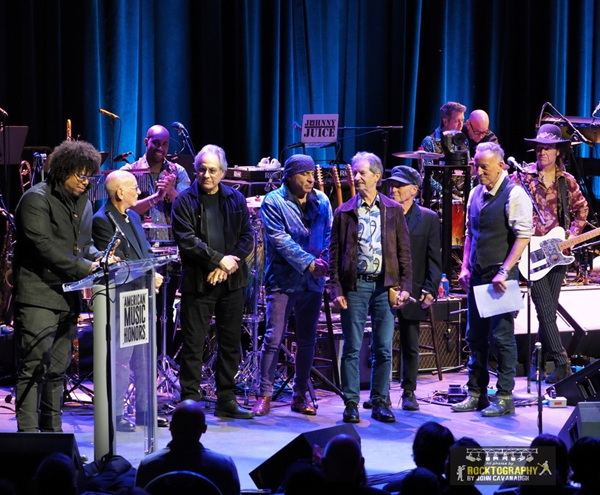
E Street Band members Van Zandt, Max Weinberg, Roy Bittan and Nils Lofgren all spoke briefly, as did Springsteen (accepting for his wife Patti Scialfa), Jake Clemons (accepting for his uncle, the late Clarence Clemons) and Jason Federici (accepting for his father, the late Danny Federici).
“I’d just like to say that this is my second family, and we have shared a unique and rare experience, to be able to play together,” said Bittan. “It’s over 50 years. And underpinning all of this is Bruce’s music and lyrics, which, you know, we get to experience very deeply every night. It’s hard to express the musical intimacy that’s been created all this time. I hope that you get to share a little bit of what we feel when we play together, every night.”
Inducting American Music Honors’ first hip-hop artist, Dr. Dre, Jimmy Iovine — the record producer and engineer, record company executive and co-founder of Dre’s Beats Electronics headphones company — traced the course of his career, starting with his membership in the group NWA. “It would be fair to say that NWA and Public Enemy were to hip-hop what The Rolling Stones and The Beatles were to rock ‘n’ roll,” Iovine said.
Iovine’s Interscope record company co-released Dre’s 1992 masterpiece The Chronic. “The tempos were slower than what was in the clubs at the time,” Iovine said. “I said to him, ‘How are they going to dance to this tempo in the clubs?’ And he said, ‘Jimmy, I’m gonna show them in the videos. And then they’re gonna dance like that in China.’ And guess what? They did. And they still are.”

JOHN CAVANAUGH
Dr. Dre at the American Music Honors show.
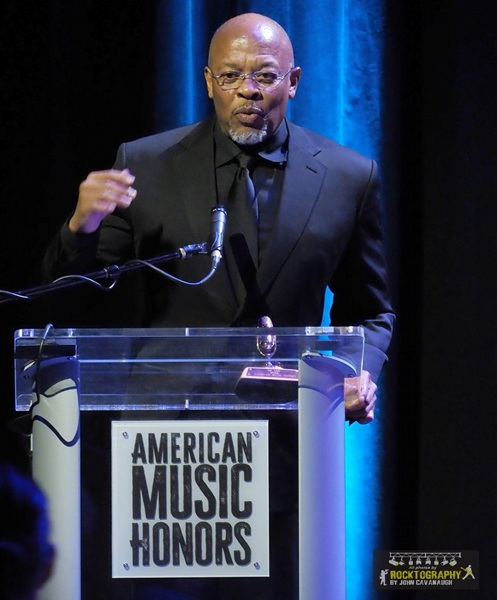
Dre spent most of his speech talking about hip-hop in general.
“So many of us early pioneers that grew up on hip-hop and watched the impact of drugs, violence, police brutality and an unfair justice system wreak havoc on our communities — and opportunities were scarce for creative young men like myself that didn’t excel in school, athletics or sports or anything like that, but had gifts just the same,” he said. “Hip-hop allowed us to be seen and heard beyond the concrete walls of our neighborhoods. And for the first time we were able to use our creativity to express our collective pain, raise social consciousness and, in my case, add elements of dark humor to the realities of life in the hood. And that, to this day, still echoes around the world. And I can’t imagine what my life would be without hip-hop right now.”
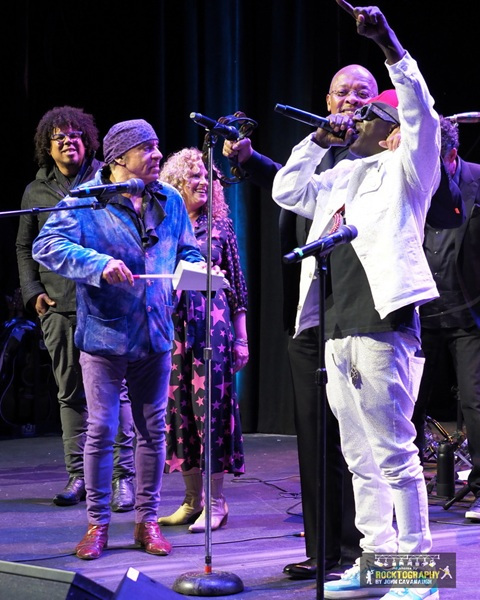
Dre didn’t perform one of his songs, but the Disciples of Soul took matters into their own hands with “California Love,” his hit collaboration with Tupac Shakur and Roger Troutman. And then Chuck D and Flavor Flav of Public Enemy, mentioned by Dre in his speech (“I used to listen to Public Enemy on my way to the studio every day on my way, making the NWA album, Straight Outta Compton … These guys are some of my biggest inspirations ever”), performed their own “Fight the Power.”
“Public Enemy is down here on the scene/With my man Dr. Dre and Bruce Springsteen!” Flavor Flav added at the end of the song.
Inducting The Doors, Van Zandt said that at first, in the ’60s, he didn’t “get” The Doors. He surmised that might have been because he was such a fan of The British Invasion that he had a prejudice against music from The West Coast.
“But the real truth was that their music was just too sophisticated for me to understand,” Van Zandt said.
“Light My Fire,” he said, may have seemed simple, “but it’s extraordinarily complicated. Jamming was all the rage in the late ’60s. There was one very big difference when The Doors were jamming. Unlike everybody else, who was just soloing to solo, with The Doors, you were witnessing the creation of live cinema verité. … the interaction of the four of them was uncanny. Their solos were adventures. The written part of the composition was just the beginning. During the solos, they were actually listening to each other — actually playing with each other, actually creating something with each other. And that alone uniquely qualifies them as one of the greatest bands in rock history.”
John Densmore accepted the award. (The band’s other surviving member, Robby Krieger, couldn’t make it because his wife is sick, Densmore explained.) Densmore talked about the band’s history, and shared some memories, and mentioned that The Doors once played at Convention Hall in Asbury Park. (With both Springsteen and his future wife, Patti Scialfa, in the audience.)
Inspired the presence of Dr. Dre and Public Enemy, Densmore said, “I came late to hip-hop. Jay-Z wanted to sample a Doors song, and we had veto power, and I thought, ‘Sample? What is that? … ‘ ‘No!’ I vetoed it. And Jay-Z wrote me a letter … breaking it down, saying, ‘Hip-hop is like, to quote Chuck D, fighting the power like The Doors did back in our day.’ ‘Oh wow. This is like the birth of a new art form. Damn.’ I flipped my veto to a yes.”

JOHN CAVANAUGH
John Densmore at the American Music Honors show.
He said the American Music Honors show was “a really healing night. This is a love fest. And in a time of hate and division. I’m thinking of Gene Simmons from Kiss, who said that hip-hop shouldn’t be in the Rock and Hall of Fame because it’s not rock. And then Chuck D brilliantly said, ‘It’s the roll! And without the roll, rock ain’t got no soul.’ ”
The three-song Doors set began with a long, improvisational “Light My Fire” featuring Springsteen, Van Zandt, Densmore and the Disciples of Soul. Echoing Jim Morrison’s approach, Springsteen held back, vocally, until the explosive final verse and chorus. His last “Fire!” was simply amazing.
Densmore left the stage, but Earle and harmonica player Mickey Raphael joined the Disciples of Soul for “Roadhouse Blues.” Then Densmore returned to help back Smith on the mystical “Crystal Ship.”
Taking the stage at the start of the show, Springsteen talked about The Springsteen Center for American Music, and all of its activities, in general. “The whole thing really got much more out of hand than I ever imagined,” he said. “You know, it started with my stuff in a little shack over in the corner of the university. Now it’s in this building. The building is nicer than my house. And I have a really nice house. So that’s gonna be something.”
He then inducted Warwick, calling her “one of my all-time favorites vocalists” and saying he has listened to her music “consistently, my entire life. … She simply has the most elegant voice in the history of popular music. It is so sophisticatedly sexy. It’s totally singular, deeply emotional, while remaining deceptively casual. She’s a minimalist. She was always there at the service of the songs and the lyrics. There was never a wasted note. The precision in her phrasing and the warmth in her tone and the intelligence in her delivery and her interpretation, it turned every one of those incredible Bacharach & David songs and lyrics into a casual conversation.
“She doesn’t perform, you know. She just seems to inhabit the lyrics and her performances are so pure that they’re filled with a very natural and special type of spiritual grace. This is a voice that there’s really not enough superlatives to describe.”

JOHN CAVANAUGH
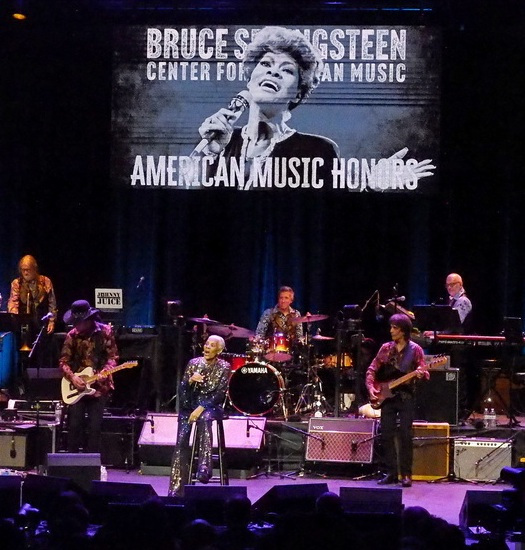
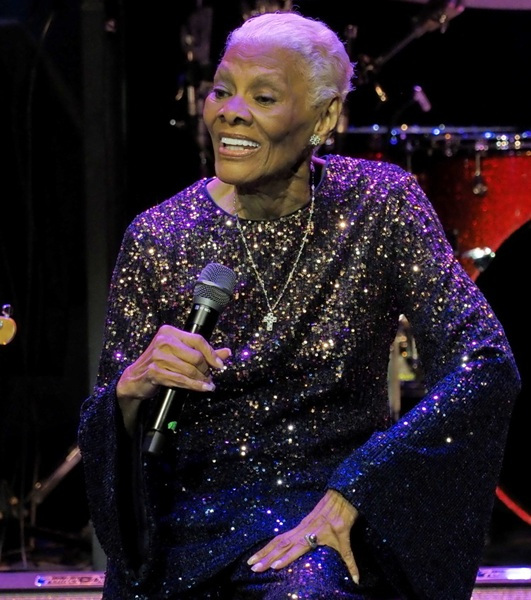
Dionne Warwick at the American Music Honors show.
His listed some of her hits, including “Are You There (With Another Girl),” which he described as “my personal favorite.”
He wrapped up the speech by saying, “Dionne, your work has been a constant companion for me and for millions of others throughout the years. I am incredibly honored to have you in our presence tonight. Thank you for a lifetime’s work.”
Warwick thanked Springsteen for “all those lovely words that you said about me. … you really know my stuff, huh?”
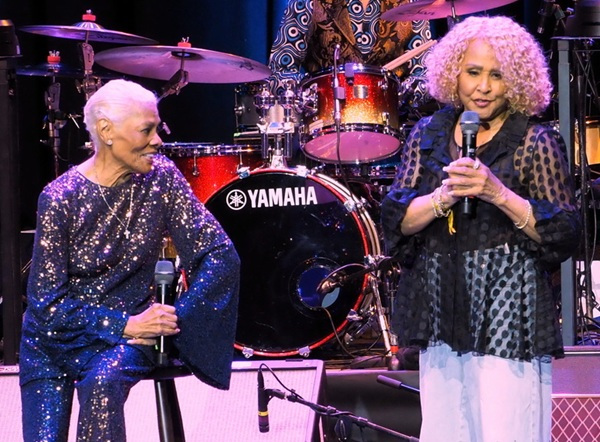
Warwick sang “Walk on By” and then introduced Darlene Love (like Earle, a 2023 American Music Awards honoree), who she called “more family than a friend.” Love mentioned that she spent “10 wonderful years” singing backing vocals for Warwick — “and now here we are together, as God wants it.” The two then sang a sweet, gentle version of “That’s What Friends Are For” together, with Raphael on harmonica.
The induction of The Band marked the first time an artist has been inducted posthumously. (All five original Band members are now deceased.) Springsteen Center executive director Robert Santelli indicated that American Music Honors will continue to honor artists posthumously, in the future, after limiting itself to living artists in its first three years.
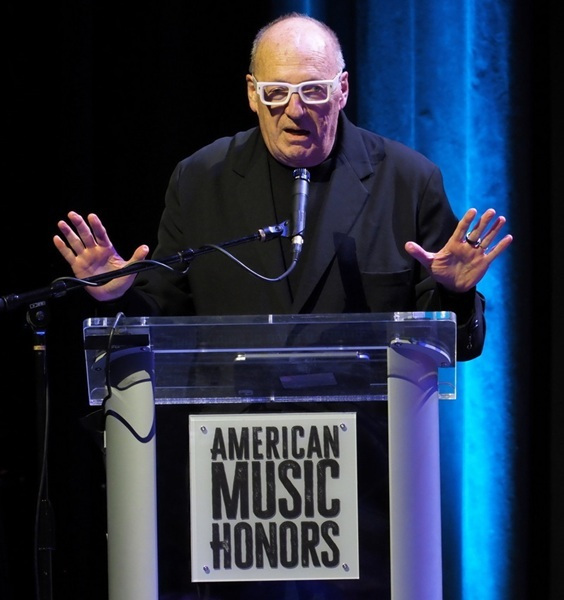
Weinberg paid tribute to The Band with a long speech that covered the group’s history and legacy, with an emphasis on Levon Helm, who was a good friend of Weinberg. One of Weinberg’s stories had to do Helm teaching him how to wield a knife (Helm called it an “Arkansas toothpick”) in bar fights; another had to do with them playing drums together on tour, and being able “get inside” Helm’s drumming, in that way. “It was the best lesson I ever had,” Weinberg said.
Helm’s daughter Amy Helm, a accomplished singer-songwriter in her own right, spoke briefly, then participated in an all-star version of The Band’s “The Weight” (also featuring Springsteen, Earle and Love) and sang lead on a funky version of the group’s “Up on Cripple Creek,” with the Disciples of Soul joined by drummer Charley Drayton.

An artist’s rendition of The Bruce Springsteen Center for American Music.
In his opening comments, Santelli said that when the American Music Honors started, four years ago, there was no public building for the Springsteen Center. Now, it is nearly built and scheduled to open imminently, on June 7, with three previously announced concerts (“Music America: The Songs That Shaped Us” shows with Springsteen, Love, Jon Bon Jovi, Kenny Chesney, Jackson Browne and many others, at the university’s OceanFirst Bank Center, June 4-5; and “America 250: A Jersey Shore Celebration of the Nation’s Music Heritage,” May 29 at The Pollak Theatre).
He also announced, though, that there will be a June 3 concert at The Pollak Theatre (lineup TBA) that will “pay tribute to the indigenous artists from all over America … we’ll recognize and celebrate those roots and their contributions to contemporary American music.” And he mentioned that the June 4-5 concerts will include covers of songs by artists such as Robert Johnson, Elvis Presley, Chuck Berry, Howlin’ Wolf, Hank Williams, Woody Guthrie and Johnny Cash.
For information on the Springsteen Center for American Music, visit springsteencenter.org.

JOHN CAVANAUGH
Dionne Warwick and Darlene Love at the American Music Honors show.
________________________________
Here is a rundown of the evening, with the musical numbers in bold (all except “Thunder Road” featured The Disciples of Soul):
Medley: “I Need a Doctor,” “Ophelia,” “Do You Know the Way to San Jose,” “Dancing Barefoot,” “Touch Me,” “No Surrender”
Brian Williams opening comments
Springsteen Center for American Music executive director Robert Santelli
Williams introduces Bruce Springsteen
Springsteen inducts Dionne Warwick
Warwick speech
Warwick: “Walk on By”
Warwick and Darlene Love, with Mickey Raphael: “That’s What Friends Are For”
Williams introduces Stevie Van Zandt
Van Zandt inducts The Doors
John Densmore speech
Springsteen, Van Zandt and Densmore: “Light My Fire”
Steve Earle and Springsteen, with Mickey Raphael: “Roadhouse Blues”
Patti Smith, Densmore: “Crystal Ship”
Williams introduces Max Weinberg
Weinberg honors The Band
Amy Helm speech
Springsteen, Helm, Love and Earle: “The Weight”
Helm, with Charley Drayton: “Up on Cripple Creek”
Williams introduces Jimmy Iovine
Jimmy Iovine inducts Dr. Dre
Dr. Dre speech
“California Love”
Public Enemy: “Fight the Power”
Williams introduces Jon Landau
Landau inducts The E Street Band
Speeches by Jason Federici (for Danny Federici), Jake Clemons (for Clarence Clemons), Roy Bittan, Weinberg, Van Zandt, Garry Tallent, Nils Lofgren, Springsteen (for Patti Scialfa)
Bruce Springsteen & the E Street Band (Van Zandt, Weinberg, Tallent, Bittan, Lofgren, Clemons, Charlie Giordano, Anthony Almonte): “Thunder Road”
Williams introduces Springsteen
Springsteen inducts Patti Smith
Smith speech
Smith with Springsteen and Tony Shanahan: “Because the Night”
Smith & Ensemble: “People Have the Power”
________________________________
The series’ past honorees have included:
2023: Sam Moore, Darlene Love, Stevie Van Zandt, Steve Earle
2024: John Mellencamp, Jackson Browne, Mavis Staples, Dion
2025: Smokey Robinson, John Fogerty, Emmylou Harris, Tom Morello, Joe Ely
_________________________________________
_________________________________________

CONTRIBUTE TO NJARTS.NET
Since launching in September 2014, NJArts.net, a 501(c)(3) organization, has become one of the most important media outlets for the Garden State arts scene. And it has always offered its content without a subscription fee, or a paywall. Its continued existence depends on support from members of that scene, and the state’s arts lovers. Please consider making a contribution of any amount to NJArts.net via PayPal, or by sending a check made out to NJArts.net to 11 Skytop Terrace, Montclair, NJ 07043.
